
How Census 2027 Identifies Buildings and Census Houses
Introduction
The upcoming Census 2027 in India marks a significant milestone as it incorporates advanced methods for identifying buildings and census houses. This article explores the systematic procedures employed during the houselisting phase and the importance of accurate classification in ensuring comprehensive data collection.
Understanding Phase I: Houselisting and Housing Census (HLO)
Census 2027 includes a two-phase approach, starting with the Houselisting and Housing Census (HLO). In this initial phase, detailed information is gathered concerning the condition of houses, available amenities, and household assets. Specifically, the HLO phase focuses on:
- The condition of structures housing the population.
- Amenities available to households, such as water, sanitation, and electricity.
- The possession of household assets.
Identification Process of Buildings and Census Houses
During the HLO phase, enumerators will follow a structured approach to identify and record buildings and census houses:
Questionnaire Structure
The Census HLO schedule consists of eight critical questions concerning houses. These questions include:
- Question 1: Line number of the house.
- Question 2: Building number.
- Question 3: Unique census house number.
- Questions 4-6: Predominant material of the floor, wall, and roof.
- Question 7: Purpose or use of the census house.
- Question 8: Overall condition of the census house.
Numbering and Mapping
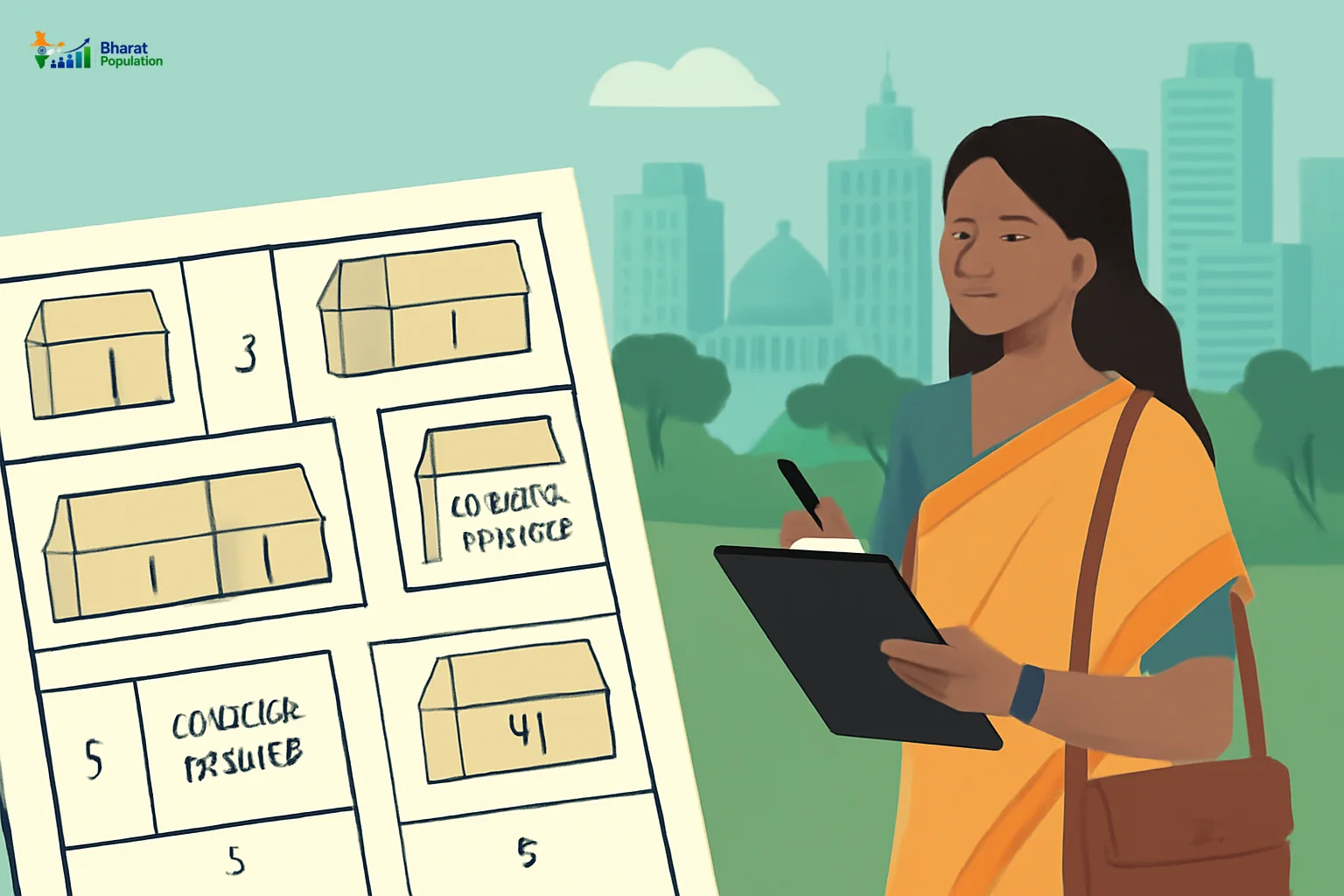
Enumerators will utilize designated numbering and mapping methods to accurately catalog buildings. Each enumerator is equipped with digital tools that allow them to:
- Create layout maps identifying each building and corresponding census houses.
- Utilize satellite imagery to prevent omissions and duplicates.
- Ensure that every building is accurately numbered and documented.
This meticulous process ensures a comprehensive database that serves not only for census purposes but also for planning and resource allocation in various sectors.
Benefits of Accurate Identification
Accurate identification of buildings and census houses is crucial for several reasons:
- Data Accuracy: Provides reliable data that supports governmental planning and development initiatives.
- Resource Allocation: Helps in the systematic distribution of public resources and amenities.
- Policy Making: Aids policymakers in addressing the specific needs of various communities based on accurate demographic data.
Digital Transition in Census 2027
Significantly, Census 2027 will be conducted through digital means, enhancing the efficiency of the data collection process. Enumerators will use secure mobile applications capable of recording houselisting data in real-time, which is pivotal for ensuring data integrity throughout the process.
Conclusion
Census 2027’s systematic identification of buildings and census houses represents a forward-thinking approach to data collection in India. With a digital framework in place, the census aims to enhance accuracy and reliability, ultimately benefiting the nation at large.
FAQs
1. What are the key components of the Houselisting phase in Census 2027?
The Houselisting phase includes gathering information on house conditions, household amenities, and other assets.
2. How will buildings be identified during Census 2027?
Buildings will be identified through a structured questionnaire that includes questions on building numbers and material structures.
3. Will the identification process be digital?
Yes, Census 2027 will utilize digital tools for data collection, ensuring real-time data accuracy.
4. What role do enumerators play in this process?
Enumerators are responsible for engaging with households, collecting data, and ensuring that every building and census house is accurately recorded.
5. Why is accurate building identification important?
It is vital for resource allocation, policy making, and providing reliable demographic data for future planning.